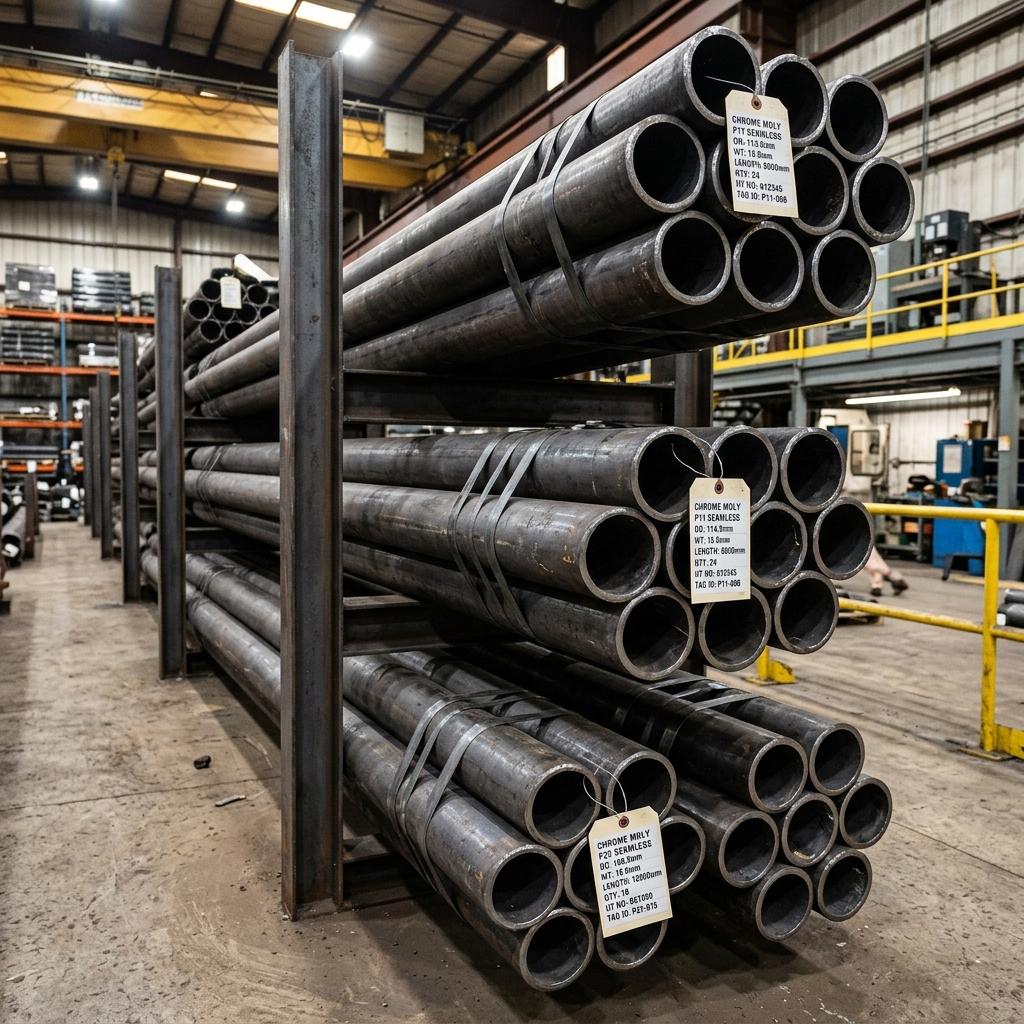
In thermal power stations, cogeneration units, and industrial steam boiler installations, piping failure is not merely an operational inconvenience — it represents a catastrophic life-safety hazard. For this reason, high-pressure steam piping in India and international territories operating under boiler jurisdiction must comply strictly with the Indian Boiler Regulations (IBR 1950). Among elevated-temperature alloy piping, ASTM A335 Grade P11 and Grade P22 are the two most critical specifications engineered to handle extreme creep and thermal fatigue.
1. What is IBR Certification?
The Indian Boiler Regulations were enacted under the Indian Boilers Act of 1923 to regulate the design, material construction, inspection, and operation of steam boilers and boiler piping systems. Any pipe carrying steam whose operating pressure exceeds 3.5 kg/cm² (gauge) or operating at temperatures above 100°C falls under statutory IBR authority.
IBR compliance is far more stringent than general commercial quality control. Material cannot simply be tested after the fact; it must be manufactured by an IBR-approved rolling mill under the surveillance of an inspecting authority recognized by the Central Boilers Board. The resulting legal documentation is Form III-A (for pipes) or Form III-G (for tubes and fittings), signed and stamped by an authorized Boiler Inspector.
2. Metallurgy: Why Carbon Steel Fails at High Steam Temperatures
Plain carbon steels (such as ASTM A106 Grade B) function reliably up to approximately 400°C (750°F). Above this threshold, carbon steel experiences two fatal metallurgical phenomena:
- Graphitization: Prolonged exposure above 425°C causes the iron carbide (cementite, Fe3C) phase to decompose into iron and nodules of free graphite along slip planes, severely embrittling the steel and precipitating sudden catastrophic rupture.
- Creep Deformation: Under continuous high-pressure stress at elevated temperatures, steel experiences slow, irreversible plastic deformation (creep), ultimately leading to micro-void coalescence and creep-rupture failure.
To counteract these degradation mechanisms, ASTM A335 introduces Chromium and Molybdenum. Chromium stabilizes carbides against graphitization and forms a protective, adherent chromium-rich oxide barrier against high-pressure steam oxidation. Molybdenum dissolves into the ferrite matrix and forms fine, stable complex carbides, drastically retarding dislocation motion and elevating creep-rupture strength up to 600°C.
3. Comparison: ASTM A335 P11 vs ASTM A335 P22
| Parameter | ASTM A335 Grade P11 | ASTM A335 Grade P22 |
|---|---|---|
| Nominal Chemistry | 1.25% Cr – 0.50% Mo | 2.25% Cr – 1.00% Mo |
| UNS Designation | UNS K11597 | UNS K21590 |
| Max Design Temperature | ≈ 550°C (1020°F) | ≈ 600°C (1110°F) |
| Min Yield Strength | 205 MPa (30,000 psi) | 205 MPa (30,000 psi) |
| Min Tensile Strength | 415 MPa (60,000 psi) | 415 MPa (60,000 psi) |
| Primary Plant Locations | Economizer lines, steam headers, boiler drum piping | Superheater loops, reheater headers, main high-pressure steam leads |
4. Fabrication & Welding: Crucial Pre-Heat and PWHT Protocols
Because both P11 and P22 alloys possess air-hardening tendencies (hardenability induced by chromium and molybdenum), improper welding without thermal conditioning results in a brittle, untempered martensite microstructure in the Heat Affected Zone (HAZ), leading to rapid hydrogen-assisted cold cracking.
Boiler contractors must adhere strictly to ASME Section IX and IBR welding procedure specifications (WPS):
- Preheating: Grade P11 requires preheating to 150°C – 200°C. Grade P22 requires 200°C – 250°C, maintained continuously throughout all welding passes.
- Interpass Temperature: Monitored strictly with temperature crayons or digital thermocouples, capped at 300°C maximum.
- Post-Weld Heat Treatment (PWHT): Following welding, the pipe joint must be subjected to subcritical stress-relief soaking. Grade P11 is soaked at 650°C – 700°C, while Grade P22 requires soaking at 680°C – 750°C for 1 hour per 25 mm of thickness, followed by controlled furnace cooling.
5. Sourcing Genuine IBR Certified Pipes in Mumbai
Navigating boiler piping procurement requires absolute confidence in supplier documentation. At Tatvam Overseas Inc, our stock of ASTM A335 P11 and P22 seamless pipes is 100% pre-inspected and certified with original IBR Form III-A reports signed by recognized Boiler Directorate inspectors.
We maintain ready inventory across Schedule 40, Schedule 80, Schedule 160, and heavy-wall XXS profiles from 1/2 inch NB to 16 inches NB in Mumbai. Every single pipe length features clean continuous paint stenciling with heat number, size, wall schedule, and IBR inspection stamp, ready for prompt dispatch to power plant shutdowns and emergency boiler turnarounds across India and overseas.