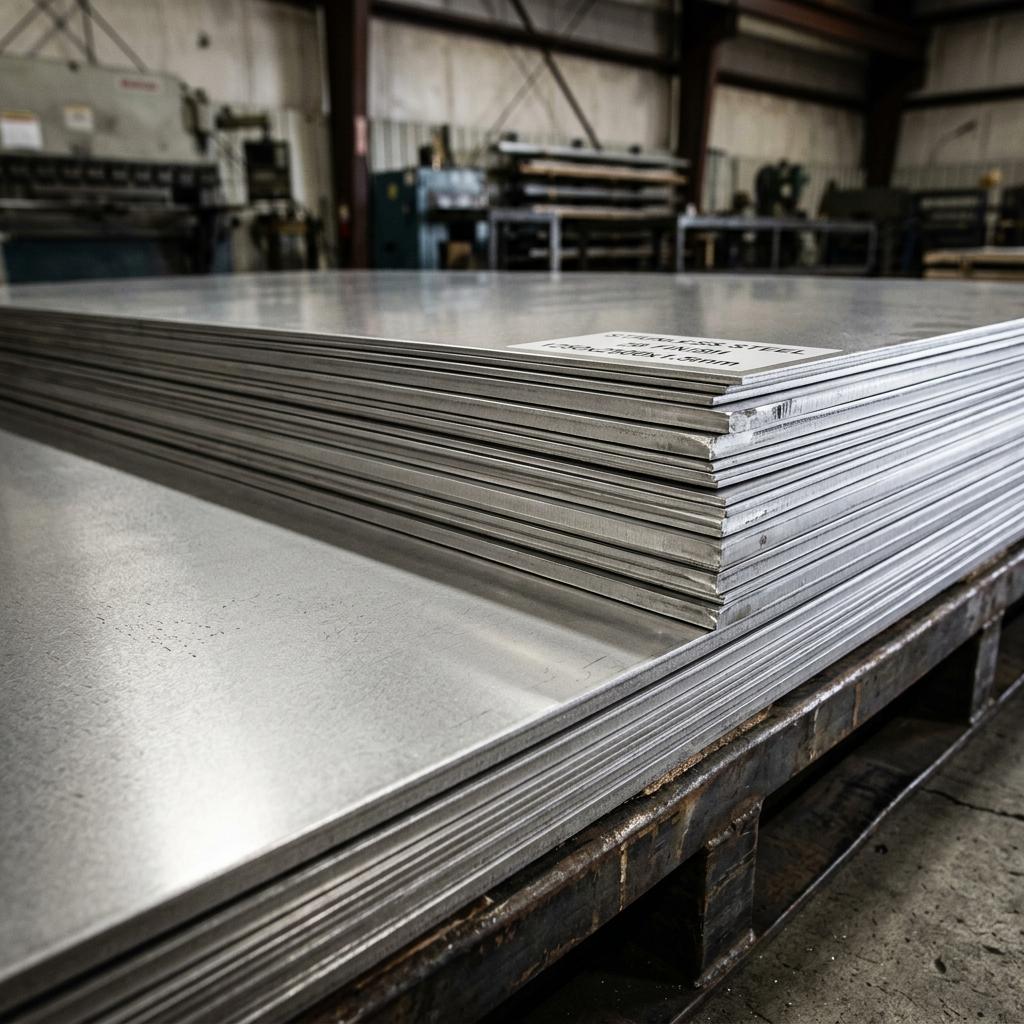
When specifying stainless steel for industrial, architectural, or process piping projects, engineers and procurement managers invariably face the decision: Grade 304 or Grade 316L? At first glance, both grades appear physically identical with identical surface reflectivity and density. However, beneath the surface lies a fundamental metallurgical difference that dictates longevity, maintenance cycles, and failure prevention in demanding environments.
1. Chemical Composition: The Molybdenum Difference
Both SS 304 and SS 316L belong to the austenitic stainless steel family, featuring a face-centered cubic (FCC) crystal lattice that provides exceptional formability, ductility, and non-magnetic characteristics in the annealed condition. The foundational difference rests in two critical elements: Molybdenum and Carbon.
Grade 304 contains 18% to 20% Chromium and 8% to 10.5% Nickel. Grade 316L increases the Nickel content to 10%–14% and incorporates 2.0% to 3.0% Molybdenum. Molybdenum alters the chemistry of the passive chromium oxide (Cr2O3) boundary film, dramatically increasing its resistance to breakdown by aggressive halide ions such as chlorides and bromides. Furthermore, the 'L' designation denotes ultra-low carbon (maximum 0.030% versus 0.08% in standard 304), which prevents chromium carbide formation along grain boundaries during heavy welding.
| Chemical Element | SS 304 (UNS S30400) | SS 316L (UNS S31603) | Role of Element |
|---|---|---|---|
| Chromium (Cr) | 18.00% – 20.00% | 16.00% – 18.00% | Primary passive oxide film formation |
| Nickel (Ni) | 8.00% – 10.50% | 10.00% – 14.00% | Stabilizes austenite structure, ductility |
| Molybdenum (Mo) | None | 2.00% – 3.00% | Crucial resistance to pitting & crevice attack |
| Carbon (C) Max | 0.080% | 0.030% | Low carbon prevents weld sensitization |
| Manganese (Mn) | ≤ 2.00% | ≤ 2.00% | Deoxidizer and hot workability |
2. Understanding Pitting Resistance Equivalent Number (PREN)
In metallurgical engineering, the susceptibility of an alloy to localized pitting corrosion in chloride solutions is quantified by the Pitting Resistance Equivalent Number (PREN). The standardized empirical formula is:
Calculating standard values:
- SS 304: 18.5 + (3.3 × 0) + (16 × 0.05) ≈ 19.3
- SS 316L: 17.0 + (3.3 × 2.2) + (16 × 0.05) ≈ 25.0
A PREN threshold of 24 is considered the minimum acceptable baseline for direct exposure to marine atmospheres, coastal fog, and de-icing road salts. Because SS 304 scores below 20, chlorides quickly break through microscopic defects in its passive film, initiating pinhole pits that rapidly propagate into catastrophic leak paths. SS 316L easily clears this threshold with a PREN of 25.
3. Welding Performance: Why the 'L' Grade Matters
When standard stainless steels containing 0.05% to 0.08% carbon are heated within the critical temperature band of 450°C to 850°C during welding, carbon atoms rapidly migrate to grain boundaries and combine with chromium to precipitate Chromium Carbides (Cr23C6). This strips chromium from the immediately adjacent crystal zones, lowering local chromium levels below the 10.5% threshold needed for passivation.
This phenomenon, known as sensitization, leaves the heat-affected zone (HAZ) vulnerable to intergranular corrosion (weld decay). Grade 316L restricts carbon to 0.030% maximum, ensuring virtually zero carbide precipitation during multi-pass welding. Thick pressure vessels, heat exchangers, and storage tanks fabricated from 316L can be placed into service without complex post-weld solution annealing.
4. Engineering Selection Matrix: When to Specify Each Grade
Choose SS 304 When:
- Operating in dry indoor or inland outdoor environments (>10 km from sea)
- Handling dairy, beverage, beer brewing, or municipal water piping
- Fabricating interior commercial kitchen counters, sinks, and food handling trays
- Architectural cladding and elevator panels in air-conditioned buildings
- Budget constraints require minimizing initial raw material procurement expenditure
Choose SS 316L When:
- Installation is coastal or offshore (within 5 km of coastline or marine mist)
- Handling chemical solutions containing sulfuric, phosphoric, or organic acids
- Manufacturing pharmaceutical reactors, CIP (Clean-In-Place) systems, or WFI piping
- Constructing exterior marine hardware, balustrades, deck fittings, or dock cranes
- Welding heavy cross-sections (>6 mm thickness) without post-weld annealing
5. Total Cost of Ownership (TCO) Comparison
At the raw material level, SS 316L typically commands a 25% to 35% price premium over SS 304, primarily driven by international LME molybdenum and nickel market quotes. However, calculating Total Cost of Ownership (TCO) paints a dramatically different picture.
If SS 304 is mistakenly installed in a coastal industrial facility (such as Mumbai, Gujarat port hubs, or UAE coastal zones), tea-staining discoloration typically appears within 6 to 12 months, followed by localized pitting within 24 months. Remedial electro-polishing, chemical passivation treatments, and eventual replacement shut down operational plants at enormous cost. Specifying SS 316L from the outset delivers 20+ years of maintenance-free service.