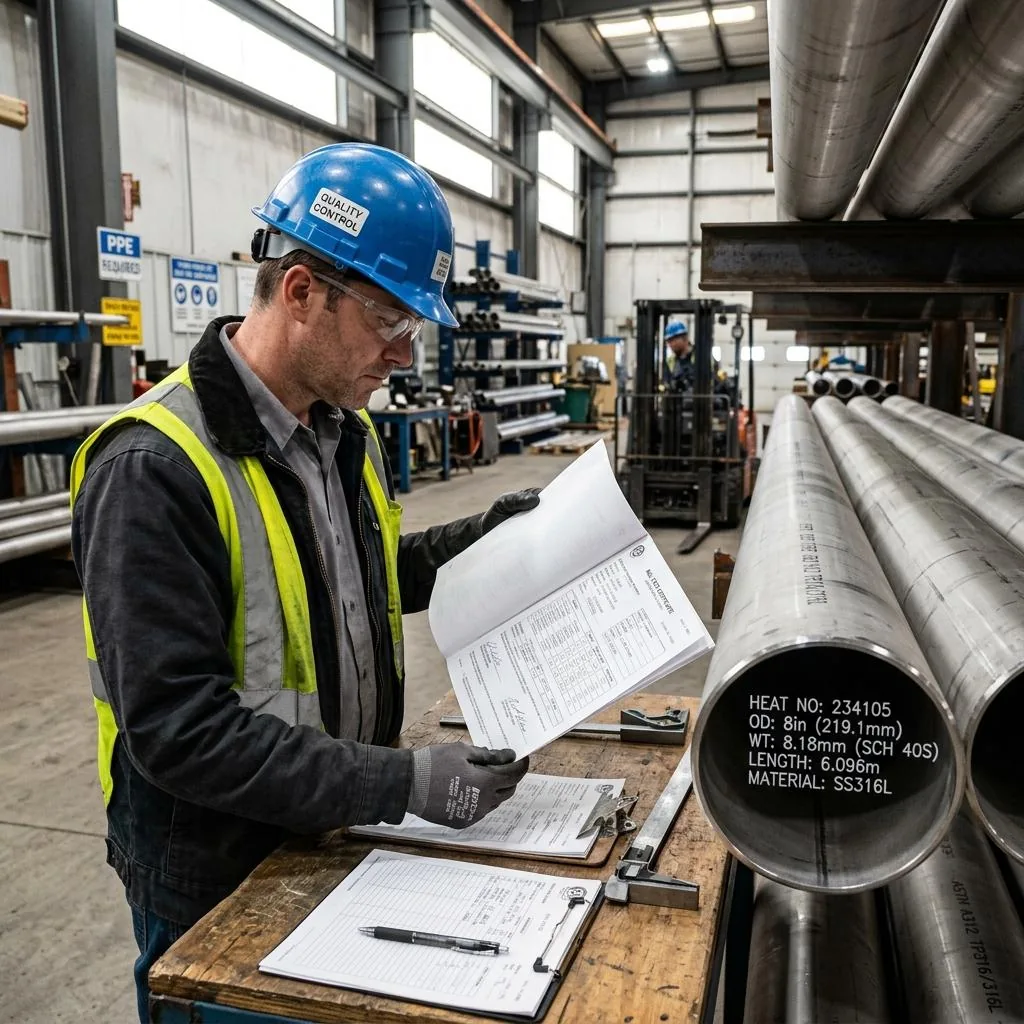
When procuring stainless steel sheets, pipes, flanges, or nickel alloy components, an authentic test certificate is the primary proof of metallurgical integrity. European Standard EN 10204 governs the inspection documents required for metallic products across global engineering projects. Understanding the difference between Type 3.1 and Type 3.2 certificates ensures compliance while avoiding unnecessary inspection costs.
The Four EN 10204 Inspection Document Types
| Document Type | Definition | Who Validates | Typical Application |
|---|---|---|---|
| EN 10204 Type 2.1 | Declaration of compliance with the order | The manufacturer | Non-critical commercial steel, general hardware |
| EN 10204 Type 2.2 | Test report based on non-specific inspection | The manufacturer | Standard stock items, non-critical fabrication |
| EN 10204 Type 3.1 | Inspection certificate based on specific testing of delivered product | Manufacturer's independent inspection representative | Standard industrial benchmark: pressure vessels, piping, SS sheets, export orders |
| EN 10204 Type 3.2 | Inspection certificate based on specific testing with independent third-party witness | Dual validation: Manufacturer representative AND Purchaser inspector or Third-Party Agency (TPI) | Critical offshore, nuclear, subsea, defense, or high-risk statutory infrastructure |
What does a 3.1 MTC contain?
An EN 10204 3.1 certificate represents specific testing conducted on the exact heat or lot delivered to the customer. A comprehensive 3.1 certificate includes:
- Manufacturer & Order Identification: Mill name, purchase order number, customer name, and invoice reference.
- Heat / Melt Number: A unique metallurgical traceability code stamped on the metal plates or pipes corresponding to the batch molten in the furnace.
- Material Specification & Grade: ASTM, ASME, EN, or IS standard (e.g. ASTM A240 Grade 304/304L or UNS S20200).
- Chemical Composition Analysis: Exact percentage by weight of alloying elements (Carbon, Manganese, Silicon, Phosphorus, Sulfur, Chromium, Nickel, Molybdenum, Nitrogen).
- Mechanical Test Results: Yield strength ($R_{p0.2}$), ultimate tensile strength ($R_m$), elongation percentage ($A$), and hardness values (HBW/HRB).
- Supplementary Quality Tests: Intergranular corrosion test (IGC per ASTM A262), flattening, flaring, hydrostatic, or eddy current tests where mandated by the product standard.
- Authorized Inspector Sign-off: The stamp and signature of the manufacturer's inspection officer, who operates independently from the manufacturing department.
EN 10204 3.1 vs 3.2: which do you need?
For most industrial projects, Type 3.1 is the standard requirement. It guarantees verified batch-specific testing without the additional lead time and inspection fees associated with external agencies.
You require Type 3.2 only when project specifications, international design codes (such as ASME Section III for nuclear, or offshore subsea pipeline rules), or regulatory authorities explicitly mandate third-party witness inspection. Under Type 3.2, an independent third-party inspection agency (such as SGS, TÜV SÜD, Bureau Veritas, or DNV) attends the mill, witnesses mechanical tensile and impact testing, checks dimensional tolerances, and co-signs the certificate alongside the mill representative.
How to check a mill test certificate
Before accepting stainless steel or alloy stock at your warehouse or job site, perform a systematic 3-step check:
- Verify Stencil vs. Certificate: Confirm that the heat number embossed, stenciled, or hard-stamped on the sheet or pipe matches the certificate characters exactly.
- Check Composition Limits: Compare the reported chemical percentages against ASTM A240 or relevant standard limits (e.g., verifying 8.0–10.5% Ni for SS 304).
- Correlate with Positive Material Identification: For high-value orders, cross-verify the piece using handheld XRF spectroscopy to ensure that pieces were not mixed during cutting or shipping.
Learn more about our quality control processes on our dedicated Quality & Mill Test Certification Hub.
Ordering 3.1 / 3.2 certified stainless steel from an Indian stockist-exporter
Tatvam Overseas Inc supplies certified SS 304 sheets & plates, SS 202 sheets, pipes, and high-nickel alloys with complete manufacturer EN 10204 3.1 MTCs.
For export orders and specialized EPC packages, We supply material with manufacturer EN 10204 3.1 mill test certificates. PMI testing and third-party inspection can be arranged on request. Third-party inspection, including for EN 10204 3.2 requirements, can be arranged on request. Contact us through our structured RFQ form or connect with our technical desk on WhatsApp.