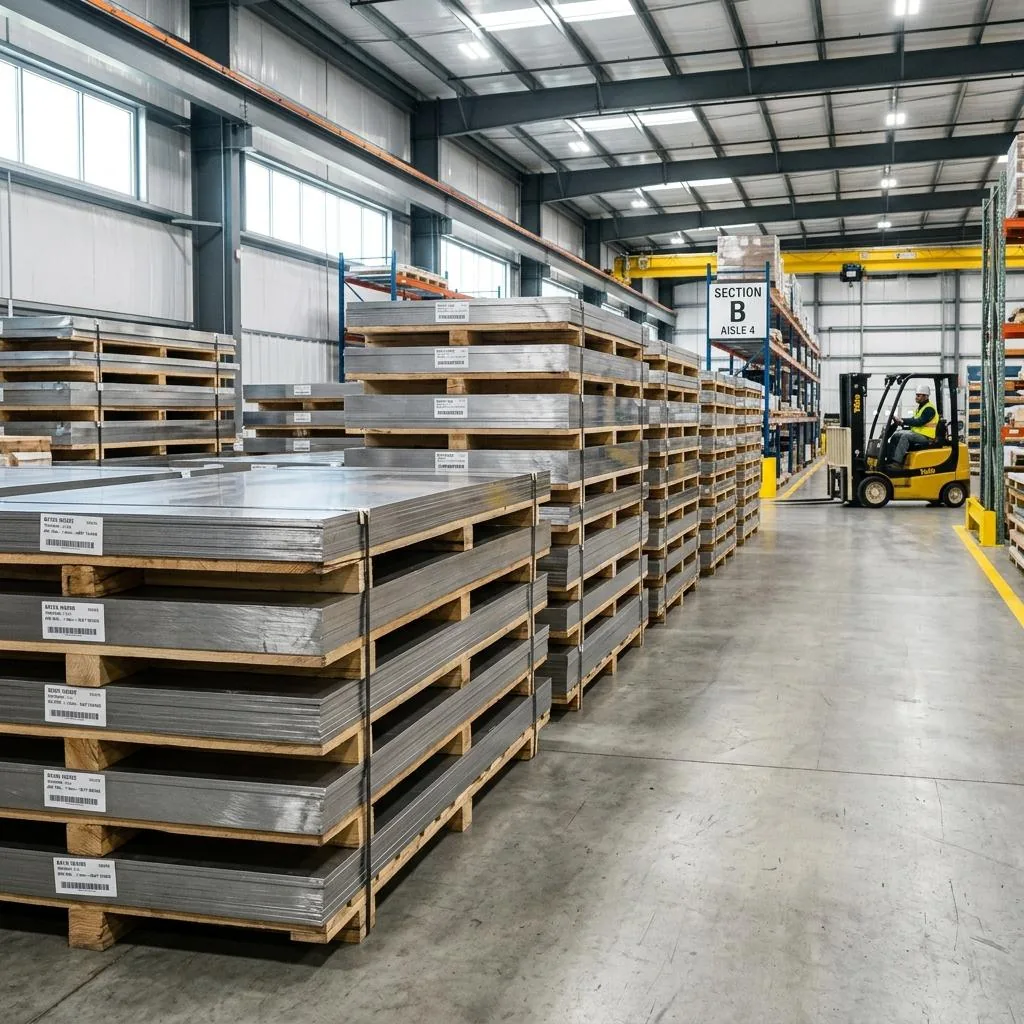
In Indian steel procurement and architectural fabrication, the dilemma between SS 202 sheets and SS 304 sheets is one of the most common buying questions. Both grades belong to the austenitic stainless family and share a similar initial appearance, yet their metallurgical composition, corrosion resistance, and total lifecycle costs differ substantially.
Comparison Table: SS 202 vs SS 304
| Parameter | SS 202 (ASTM A240 UNS S20200) | SS 304 (ASTM A240 UNS S30400) |
|---|---|---|
| Standard Spec | ASTM A240 / IS 6911 | ASTM A240 / EN 10088-2 |
| Chromium (Cr) | 17.0 – 19.0% | 17.5 – 19.5% |
| Nickel (Ni) | 4.0 – 6.0% | 8.0 – 10.5% |
| Manganese (Mn) | 7.5 – 10.0% | 2.00% max |
| Carbon (C) | 0.15% max | 0.07% max (304L: 0.030% max) |
| Nitrogen (N) | 0.25% max | 0.10% max |
| Density | 7.80 g/cm³ | 7.93 g/cm³ |
| Corrosion Resistance | Moderate; for dry, non-coastal indoor use | High; robust passive film for wet/food environments |
| Relative Price Position | Lower cost base (economical) | Higher initial investment (prime benchmark) |
| Primary Uses | Indoor furniture, architectural trims, dry utensils | Kitchen sinks, dairy/brewing, chemical tanks, facades |
What is SS 202 stainless steel?
SS 202 is an austenitic grade belonging to the 200-series (chromium-nickel-manganese) family, standardized under ASTM A240 UNS S20200 and Indian Standard IS 6911. It was engineered to reduce reliance on costly nickel by employing manganese and nitrogen as austenite stabilizers. This metallurgy gives 202 good formability, tensile strength, and aesthetic appeal at a significantly lower initial raw material cost than 300-series alloys.
SS 202 composition and nickel percentage
Under the ASTM A240 specification, standard SS 202 contains 17.0% to 19.0% Chromium and 4.0% to 6.0% Nickel, with 7.5% to 10.0% Manganese and up to 0.25% Nitrogen. Commercial Indian market variants, such as Jindal J1 and J4, are custom sub-chemistries where nickel is balanced with added copper to optimize press forming for utensils and interior panels. By contrast, ASTM A240 SS 304 contains 8.0% to 10.5% Nickel and 17.5% to 19.5% Chromium. The higher nickel content in 304 provides higher ductility and a more stable, self-repairing chromium oxide passive barrier. To understand how alloy pricing fluctuates with nickel markets, read our guide on SS sheet price per kg factors in India.
Is SS 202 rust proof?
No stainless steel is completely immune to corrosion. SS 202 forms a protective chromium passive film under dry, clean atmospheric conditions. However, because manganese compounds replace nickel, the passive barrier is significantly less stable when exposed to chlorides, salt spray, atmospheric sulfur dioxide, or standing water.
In outdoor, coastal (such as Mumbai, Chennai, or Kochi), or humid environments, SS 202 develops superficial brown staining ("tea-staining") that can progress into localized pitting corrosion. For exterior architectural cladding or coastal installations, SS 304 or molybdenum-bearing SS 316L is essential.
SS 202 vs SS 304 for kitchen use
In kitchen and catering environments, the distinction between wet food contact and dry structural components is critical:
- Wet prep tables, sinks, dishwashing units, and cookware: SS 304 is strictly recommended. Food salts, vinegar, citric acids, and chemical dishwashing detergents can break down the passive film of SS 202, causing pitting where bacteria can lodge. SS 304 meets standard international hygiene and food-contact criteria.
- Dry storage racks, cabinet doors, and display panels: SS 202 can be effectively utilized for dry storage shelves, dining furniture frames, and decorative partition screens, where routine contact with liquid food and acidic condiments is absent.
How to identify SS 202 vs SS 304
Material mix-ups can be costly. When verifying shipments of stainless steel sheets, pipes, or plates, follow these testing guidelines:
1. The Magnet Test Fallacy
A magnet test cannot reliably differentiate SS 202 from SS 304. Both alloys are austenitic and non-magnetic in their fully annealed state. When sheared, bent, or deep-drawn, both grades undergo strain-induced transformation to martensite and show mild magnetic pull. Never reject or accept material based on a magnet alone.
2. Positive Material Identification (PMI) & XRF Testing
Handheld X-ray Fluorescence (XRF) spectroscopy provides nondestructive elemental analysis in seconds. A certified PMI gun instantly measures nickel (8–10.5% for 304 vs 4–6% for 202) and manganese percentages, verifying the heat chemistry on site.
3. Mill Test Certificates (EN 10204 3.1)
Every prime order must be accompanied by an authentic manufacturer inspection certificate showing chemical melt analysis, mechanical tensile values, and lot heat numbers matching the stencil on the sheet. Learn how to verify certificates in our guide on EN 10204 3.1 vs 3.2 mill test certificates.
Weight Planning & Estimation
Because of slight density variations (7.93 g/cm³ for SS 304 vs 7.80 g/cm³ for SS 202), calculating total payload and project requirements requires accurate calculations. Check our interactive Stainless Steel Weight Calculator or review our SS sheet weight formula and 4x8 ft weight chart. For live inquiries and material availability, contact our sales desk in Mumbai.